
Pine Tree Guide Dog Users (PTGDU)
“Opening Doors to Independence and Opportunity”
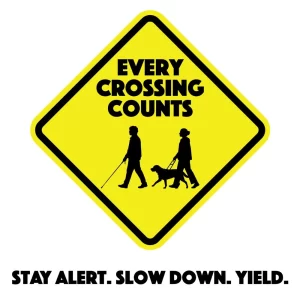
Special Edition: Every Crossing Counts Campaign
Welcome to this special edition of the Pine Tree Guide Dog Users Monthly News Update, a nationally recognized publication for guide dog handlers and others interested in the guide dog movement. Read the archives at www.PineTreeGuideDogUsers.org/monthly-news-updates
Community Connect
This section features community updates and more.
- Every Crossing Counts is here! We’re excited to launch Every Crossing Counts, a new public safety awareness campaign encouraging drivers and cyclists to make street crossings safer for pedestrians who are blind or have low vision. We’ve created free resources to make it easy for members and friends to spread the word in their communities. Take a look at EveryCrossingCounts.org and help us get the message moving!
- Perfect timing. October is Blindness Awareness Month, and October 15 is White Cane Safety Day. What better time to launch Every Crossing Counts and get the conversation about safer crossings on the move? First recognized in 1964 through a joint resolution of Congress and a proclamation by President Lyndon B. Johnson, White Cane Safety Day celebrates the white cane as a symbol of independence and mobility. It’s also a timely reminder for drivers and cyclists to watch for pedestrians using white canes or guide dogs and give them the time and space to cross safely.
- Ready to hit the road? Throughout October, we’ll be posting campaign messages, photos, and information on our Facebook page. Please follow along and share our posts with friends, family, and others in your community.
- Look who’s in the news! PTGDU members Angi Cosand, with her white cane, and Jim Kutsch, with his Seeing Eye dog Easton, were featured in a local Maine news release about Every Crossing Counts. The photos also include local cyclists and a police officer, bringing our Stay Alert. Slow Down. Yield. message close to home. Want to share the story in your own community? Adapt the sample press release on our resources page with local details and send it to your news outlets. Let us know if you would like help.
- Real people. Real experiences. Our new Real Stories page shares personal accounts from pedestrians who are blind or have low vision, along with news reports about actual collisions. These experiences show how quickly an ordinary street crossing can become dangerous and why the actions of others on the road matter.
Advocacy Matters
This section features news on access and legislative issues.
- Safer crossings are a shared effort. Drivers and cyclists have a responsibility to stay alert, slow down, and yield. Pedestrians who are blind or have low vision have a part to play, too. This guide by Janet Barlow, Billie Louise (Beezy) Bentzen, and Lois Thibault offers ways to assess unfamiliar crossings using traffic sounds, landmarks, and accessible pedestrian signals. It also explains how to request improvements when a crossing lacks reliable cues.
- Did you know? Displaying a white cane does not always prompt drivers to yield, and limited evidence suggests drivers may yield less often to guide dog teams. In Drivers’ Yielding Behavior, orientation and mobility specialist Eugene Bourquin discusses the research and strategies that may increase the likelihood of drivers yielding.
- It’s the law! White Cane Safety Day draws attention to state laws concerning pedestrians who use white canes or guide dogs. Provisions vary by state. Explore the American Council of the Blind’s web page on White Cane Laws for statutes, penalties, and excerpts from driver manuals.
- Keep it moving! Ready to share Every Crossing Counts locally? Our Bring the Campaign to Your Community page has free flyers, brochures, a poster, A Driver’s Guide to Safer Street Crossings, children’s bookmarks, and other materials, plus ideas for reaching libraries, schools, driver education programs, cycling groups, and community organizations. It also includes a sample press release and talking points to help you get started.
Let’s Talk About Every Crossing Counts!
This section shares materials, outreach tools, and updates related to the Every Crossing Counts campaign.
You’ve read about the campaign and the resources available to share. If someone asks what Every Crossing Counts is or what drivers and cyclists should do, the talking points document below can help you answer. Use what’s useful, whether you’re having a quick conversation or introducing the campaign to a community group.
TALKING POINTS
A public safety awareness campaign making street crossings safer for blind and low vision pedestrians.
THE MAIN MESSAGE
Street crossing safety is a shared responsibility. People who are blind or have low vision travel independently using white canes, guide dogs, specialized travel skills, and information from their surroundings. Drivers and cyclists share responsibility through their actions on the road.
WHAT IS EVERY CROSSING COUNTS?
· Every Crossing Counts is a public safety awareness campaign developed by Pine Tree Guide Dog Users with contributions from organization members, guide dog schools, blindness professionals, and community partners.
· The campaign teaches drivers and cyclists how to recognize pedestrians using white canes and guide dogs and how to respond safely.
· Recognizing a white cane or guide dog is an important first step, but recognition alone is not enough. Knowing how to respond matters, too.
WHAT SHOULD DRIVERS AND CYCLISTS DO?
1. Stay Alert
· Watch for pedestrians using long white canes or guide dogs wearing specialized harnesses with rigid handles.
· A white cane or guide dog signals that the pedestrian is blind or has low vision.
2. Slow Down
· Use extra caution when approaching a pedestrian using a white cane or guide dog.
· Slowing down provides more time to assess the situation and respond safely.
3. Yield
· Give the right of way.
· Allow the pedestrian sufficient time and space to make a safe crossing.
WHY ARE PREDICTABLE ACTIONS IMPORTANT?
· Pedestrians who are blind or have low vision often use traffic sounds and vehicle movement to understand how traffic is moving and decide when to cross.
· Following traffic laws, including applicable white cane laws, allows pedestrians to better anticipate what drivers and cyclists will do.
· Coming to a complete stop when yielding makes the vehicle’s movement easier to interpret than slowing or rolling forward. Keeping the crossing clear also provides the pedestrian with an unobstructed path.
WHY ARE COMMON COMMUNICATION SIGNALS UNRELIABLE?
· Eye contact, hand gestures, and head nods depend on visual information that a pedestrian who is blind or has low vision may not see.
· Pedestrians can only guess whether a horn, bicycle bell, or shouted instruction is meant for them or another road user. Even when the sound is directed at them, it does not reliably convey what action they are expected to take or whether traffic in other lanes or approaching from other directions has stopped.
· These sounds can also make pedestrians feel pressured to cross before they are ready, startle them, or drown out important auditory cues.
WHAT OTHER CONDITIONS CAN AFFECT A CROSSING?
· Much of the visual information used for crossing streets—such as pedestrian signals, turn signals, and the ability to watch traffic—is often unavailable to pedestrians who are blind or have low vision.
· Electric, hybrid, and auto start-stop equipped vehicles can be more difficult to detect by sound.
· Roadway features and traffic conditions—including multiple lanes, turning traffic, roundabouts, floating bus stops, higher speeds, and complex signal patterns—can make crossings more difficult to assess.
WHAT SHOULD PEOPLE UNDERSTAND ABOUT WHITE CANES AND GUIDE DOGS?
· A long white cane, with or without a red tip, is an internationally recognized symbol of blindness and low vision.
· Unlike a pet dog being walked on a leash, a working guide dog wears a specialized harness with a long, rigid handle that the pedestrian uses for guidance.
· White canes and guide dogs are mobility aids that support safe, independent travel.
· In most states, white cane laws provide heightened protections for pedestrians using white canes or guide dogs.
A SIMPLE WAY TO EXPLAIN THE CAMPAIGN
“People who are blind or have low vision cross streets independently using white canes and guide dogs. Every Crossing Counts reminds drivers and cyclists that street crossing safety is a shared responsibility: Stay Alert. Slow Down. Yield.”
LEARN MORE AND SHARE THE CAMPAIGN
Free flyers, brochures, campaign information, and other materials are available at:
The People Behind Every Crossing Counts
- Picture this! Leader Dogs for the Blind, The Seeing Eye, and Guiding Eyes for the Blind generously shared photos for the campaign website, brochure, flyer, and children’s bookmarks. Dave Cleaveland of Maine Imaging captured more images here in Maine, and designer Chris Espiritu helped bring the campaign’s message to life across our materials. We’re grateful for their talent and generosity.
- Small but mighty! The PTGDU board envisioned a public safety campaign that anyone could share, and our publications team got to work. Special thanks to team members Jim and Sue Martin, Christina Brino, Bonnie Mosen, and team leader Ginger Kutsch for creating and assembling campaign materials; to PTGDU members Angi Cosand, Andrea Giudice, and Jim Kutsch for participating in photo shoots; and to Steve Lambert for building EveryCrossingCounts.org and posting the resources online.
PTGDU Recipe of the Month
This section features a favorite recipe from the guide dog community.
A Recipe for Safer Street Crossings
Prep time: A few seconds
Serves: Everyone at the intersection
Ingredients
- A generous helping of attention
- One complete stop
- A clear crosswalk
- Enough time and space for the pedestrian to cross
- A pinch of patience
Directions
Spot a white cane or guide dog? Turn down your speed and bring your vehicle to a complete stop. Keep the crosswalk clear, then give the pedestrian time to cross. Skip the hand waves and honks; they don’t reliably tell someone who is blind what traffic is doing.
Chef’s tip: The secret ingredient is being predictable.
Stay Alert. Slow Down. Yield.
About Us
This monthly news update is a publication of Pine Tree Guide Dog Users (PTGDU), an independent, nonprofit membership organization serving blind and low vision residents of Maine and beyond. Founded in 1997, PTGDU works to promote the equality and inclusion of guide dog teams in all aspects of life. Visit us on the web, explore our Every Crossing Counts campaign, or follow us on Facebook.